 281-623-1105

Lab-grown diamonds have transformed the jewelry industry by offering a beautiful, ethical, and often more affordable alternative to mined diamonds. But not all lab diamonds are created the same way. The two primary growth methods—HPHT (High Pressure High Temperature) and CVD (Chemical Vapor Deposition)—produce real diamonds with slightly different characteristics.
What Are Lab-Grown Diamonds?
First, it’s important to clarify: both HPHT and CVD diamonds are real diamonds. They have the same chemical composition (pure carbon), crystal structure, hardness (10 on the Mohs scale), and optical properties as natural diamonds. Even professional jewelers need advanced equipment to tell them apart from mined stones.
The difference lies in how they are grown in the lab.
HPHT Diamonds (High Pressure High Temperature)
HPHT is the original lab-diamond growth method and was developed to mimic the natural conditions under which diamonds form deep within the earth.
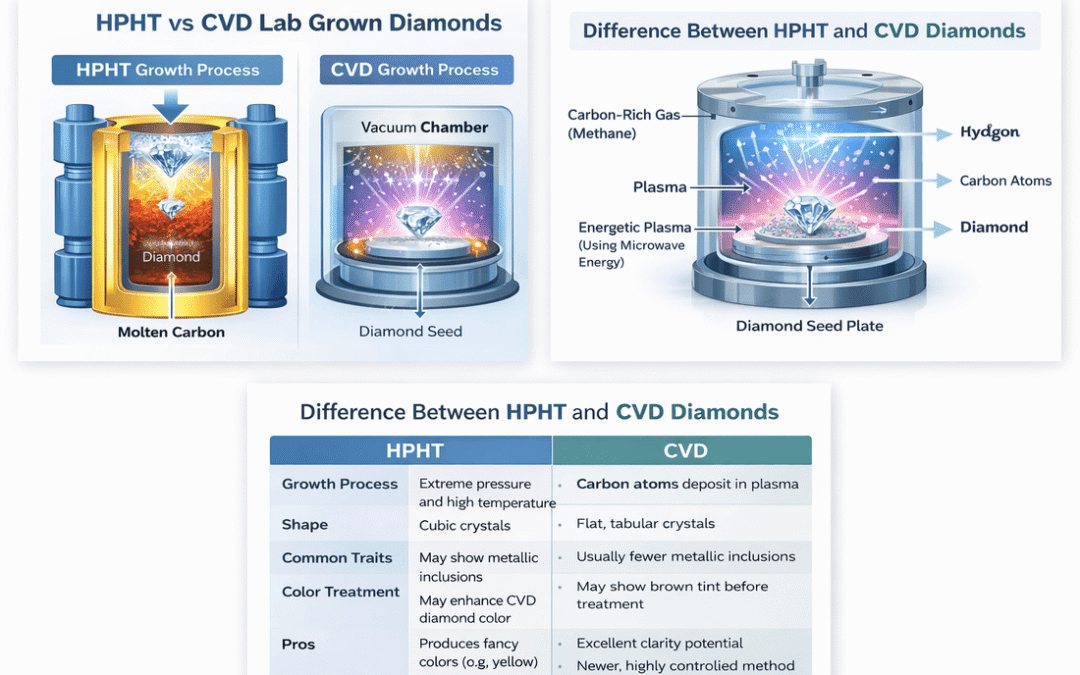
How HPHT Works
- A tiny diamond seed is placed in carbon.
- The chamber applies extreme pressure (about 5–6 GPa) and very high heat (around 1,300–1,600°C)
- The carbon melts and crystallizes around the seed, forming a diamond.
Key Characteristics of HPHT Diamonds
- Often grow faster and in cubic shapes
- May show metallic inclusions (from the growth catalyst)
- Historically more common in colorless and fancy color stones
- Sometimes used as a post-growth treatment for CVD diamonds to improve color
Pros
- Can produce very high color grades
- Efficient for certain fancy colors (like yellow)
- Long-established technology
Considerations
- Potential for metallic inclusions (usually microscopic)
- Growth environment is more mechanically intensive
CVD Diamonds (Chemical Vapor Deposition)
CVD is a newer, highly controlled process that builds diamonds layer by layer from carbon-rich gas.
How CVD Works
- A thin diamond seed plate is placed in a vacuum chamber.
- Carbon-rich gas (usually methane) is introduced.
- The gas is energized into plasma.
- Carbon atoms slowly deposit onto the seed, growing the diamond layer by layer.
Key Characteristics of CVD Diamonds
- Typically grow in flat, tabular crystals
- Often have fewer metallic inclusions
- May show brownish tint before treatment
- Very popular for high-clarity stones
Pros
- Excellent clarity potential
- Highly controlled growth environment
- Fewer metallic inclusions
- Scalable for commercial production
Considerations
- Often requires post-growth treatment for best color
- Growth process is slower
Visual Differences: Can You Tell?
To the naked eye—and even under a jeweler’s loupe—HPHT and CVD diamonds usually look identical when well cut and graded.
Differences are typically only detectable with advanced lab equipment that analyzes:
- Growth patterns
- Trace elements
For consumers, the cut quality, color, and clarity matter far more than the growth method.
Which Is Better?
The honest answer: neither is universally better.
Both HPHT and CVD can produce:
- D–F colorless diamonds
- VS and higher clarity
- Excellent cut stones
- GIA or IGI certified diamonds
What truly determines beauty and value is:
- Cut precision
- Overall proportions
- Polish and symmetry
- Eye-clean appearance
What Matters Most
When choosing a lab grown diamond, focus on what ia actually important:
- Sparkle and brilliance
- Size for budget
- Certification (GIA or IGI)
- Eye-clean clarity
- Strong cut quality
HPHT and CVD lab-grown diamonds are two advanced technologies that both produce beautiful diamonds. While the growth processes differ significantly, the finished stones—when properly cut and graded—can be virtually indistinguishable in everyday wear.
For most buyers, the smartest approach is simple:
choose the diamond that looks the best to your eye and fits your budget.
FAQs
Is HPHT or CVD better for lab-grown diamonds?
Can you tell the difference between HPHT and CVD diamonds?
Can you tell the difference between HPHT and CVD diamonds?
Are HPHT and CVD diamonds real diamonds?
Do CVD diamonds need treatment?
Which lab-grown diamond method is more affordable?